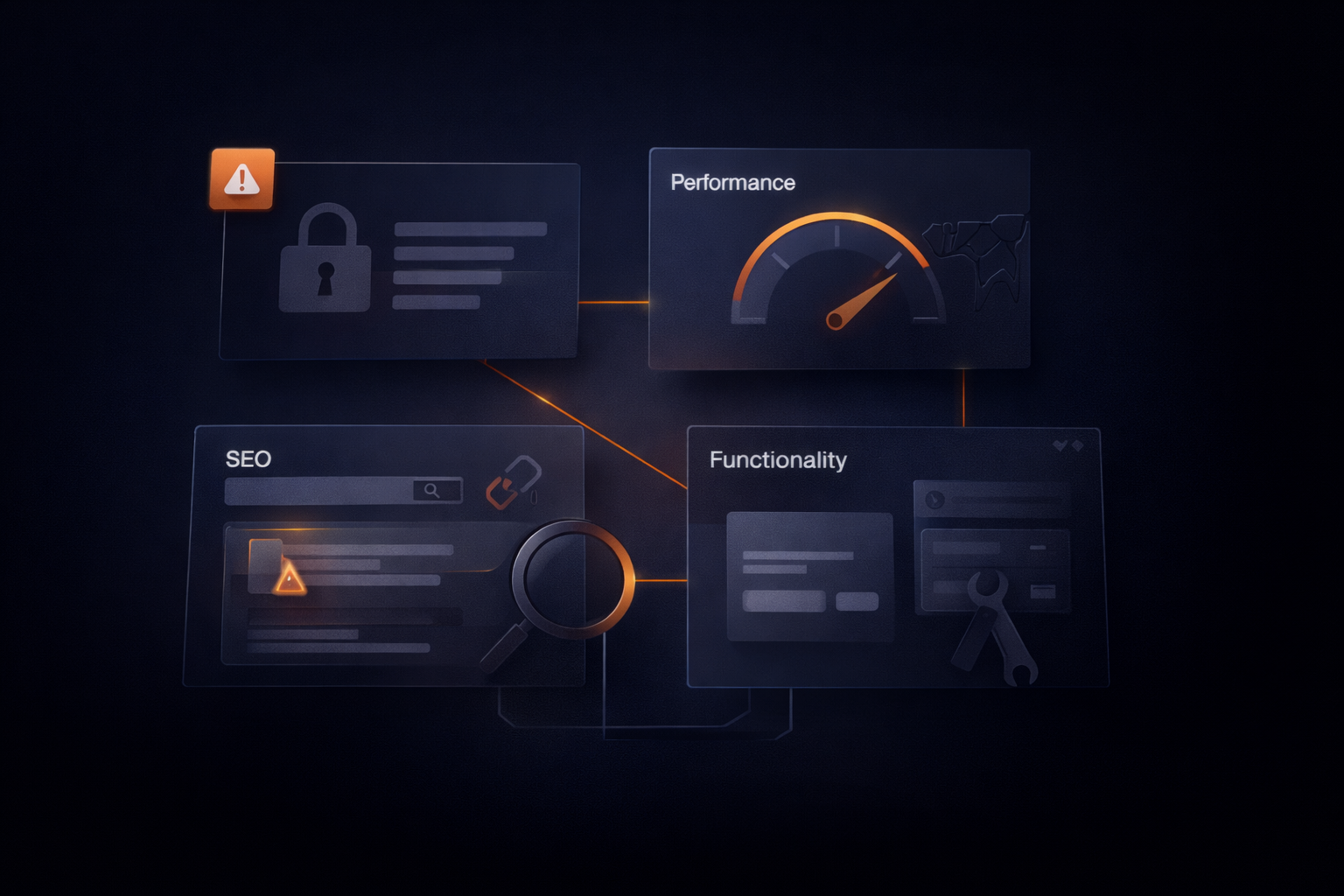
TL;DR — Improve Website Functionality in 2026
- Website functionality in 2026 means speed, stability, and seamless user experience
- Core Web Vitals are now a direct Google ranking factor — failing sites get buried
- Every 1-second delay in load time reduces conversions by 7% and increases bounce by 11%
- Mobile-first isn’t optional — 70%+ of traffic is mobile, and Google indexes mobile first
- Regular performance monitoring catches issues before they cost you customers
- Functional websites convert 3-5x better than slow, broken alternatives
👉 Related: Website Speed Optimization Service
Table of Contents
- What “Website Functionality” Means in 2026
- Why Functionality Directly Impacts Revenue
- Way #1: Optimize for Core Web Vitals
- Way #2: Prioritize Mobile-First Performance
- Way #3: Implement Continuous Performance Monitoring
- The Complete Functionality Checklist
- Common Functionality Killers (And How to Fix Them)
- Case Study: Functionality Transformation
- Functionality Comparison Table
- FAQ
What “Website Functionality” Means in 2026
Website functionality has evolved far beyond “does the site load?”
In 2026, a functional website means:
| Dimension | What It Means | Why It Matters |
|---|---|---|
| Speed | Loads in under 2 seconds | Users leave slow sites; Google demotes them |
| Stability | Doesn’t shift, break, or error | Visual stability builds trust |
| Responsiveness | Reacts instantly to user input | Slow interactions frustrate users |
| Accessibility | Works for all users, all abilities | Legal requirement + larger audience |
| Reliability | Works consistently, 99.9%+ uptime | Downtime = lost revenue |
| Cross-device | Perfect experience on any device | Users switch devices; experience should be seamless |
A “functional” website in 2015 just needed to load. A functional website in 2026 needs to be fast, stable, responsive, accessible, reliable, and device-agnostic.
👉 Related: Technical SEO Checklist 2026
Why Functionality Directly Impacts Revenue
This isn’t abstract — functionality has concrete financial consequences:
Speed Impact on Conversions
| Load Time | Conversion Impact | Bounce Rate |
|---|---|---|
| 1 second | Baseline | 7% |
| 2 seconds | -7% | 11% |
| 3 seconds | -14% | 24% |
| 4 seconds | -21% | 38% |
| 5 seconds | -28% | 49% |
| 6+ seconds | -35%+ | 60%+ |
Source: Google/Deloitte research
For a site generating $100,000/month:
- 3-second load time → losing $14,000/month
- 5-second load time → losing $28,000/month
Ranking Impact
Google uses Core Web Vitals as a ranking signal. Sites failing these metrics see:
- Lower positions for competitive keywords
- Reduced visibility in AI search results
- Less crawl frequency from Googlebot
Trust and Brand Impact
Users make judgments instantly:
- Slow sites = unprofessional
- Broken sites = untrustworthy
- Difficult sites = frustrating to work with
61% of users won’t return to a site they had trouble using. (Google)
👉 Related: Conversion Optimization 2026
Way #1: Optimize for Core Web Vitals
Core Web Vitals are Google’s three key performance metrics. Passing all three is essential in 2026.
LCP (Largest Contentful Paint)
What it measures: How quickly the main content becomes visible Target: Under 2.5 seconds Status thresholds:
- Good: ≤ 2.5s
- Needs Improvement: 2.5s – 4.0s
- Poor: > 4.0s
Common LCP Problems and Fixes:
| Problem | Solution |
|---|---|
| Slow server response | Upgrade hosting, use CDN |
| Render-blocking resources | Defer non-critical CSS/JS |
| Large images | Compress, use WebP/AVIF, lazy load |
| Client-side rendering | Implement SSR or pre-rendering |
INP (Interaction to Next Paint)
What it measures: How quickly the page responds to user interactions Target: Under 200 milliseconds Status thresholds:
- Good: ≤ 200ms
- Needs Improvement: 200ms – 500ms
- Poor: > 500ms
Common INP Problems and Fixes:
| Problem | Solution |
|---|---|
| Heavy JavaScript | Code split, remove unused JS |
| Long tasks | Break up into smaller tasks |
| Third-party scripts | Audit and remove unnecessary |
| Large DOM size | Simplify page structure |
CLS (Cumulative Layout Shift)
What it measures: Visual stability (does content jump around?) Target: Below 0.1 Status thresholds:
- Good: ≤ 0.1
- Needs Improvement: 0.1 – 0.25
- Poor: > 0.25
Common CLS Problems and Fixes:
| Problem | Solution |
|---|---|
| Images without dimensions | Always specify width/height |
| Ads/embeds loading late | Reserve space with CSS |
| Web fonts causing shift | Use font-display: swap |
| Dynamic content injection | Reserve space before loading |
How to Check Your Core Web Vitals
- Google PageSpeed Insights — pagespeed.web.dev
- Google Search Console — Core Web Vitals report
- Chrome DevTools — Lighthouse audit
- Web Vitals Extension — Real-time monitoring
👉 Related: Full Speed Optimization Guide 2026
Way #2: Prioritize Mobile-First Performance
70%+ of web traffic is mobile. Google uses mobile-first indexing — your mobile site IS your site.
Mobile Performance Essentials
1. Responsive Design
Your site must adapt fluidly to any screen size:
- Flexible grids and layouts
- Flexible images (max-width: 100%)
- CSS media queries for breakpoints
- No horizontal scrolling at any size
2. Touch-Friendly Interface
Mobile users tap, not click:
- Minimum tap target size: 48×48 pixels
- Adequate spacing between interactive elements
- No hover-dependent functionality
- Easy-to-use mobile navigation
3. Mobile Page Speed
Mobile networks are slower than desktop:
- Target load time: under 3 seconds on 4G
- Compress images aggressively
- Minimize HTTP requests
- Enable text compression (Gzip/Brotli)
4. Thumb-Friendly Design
Consider how users hold phones:
- Important actions in thumb reach zone
- Avoid top corners for primary CTAs
- Bottom navigation for frequent actions
Mobile Testing Tools
- Google Mobile-Friendly Test — Quick pass/fail
- Chrome DevTools Device Mode — Simulate any device
- BrowserStack — Test on real devices
- Your actual phone — Nothing beats real-world testing
Common Mobile Issues to Fix
| Issue | Impact | Solution |
|---|---|---|
| Text too small | Users can’t read without zooming | Min 16px base font |
| Tap targets too close | Frustrating misclicks | 48px minimum with 8px spacing |
| Viewport not configured | Page doesn’t scale properly | Add viewport meta tag |
| Content wider than screen | Horizontal scrolling required | Fix CSS overflow issues |
| Intrusive interstitials | Google penalizes, users hate | Use non-intrusive alternatives |
👉 Related: Mobile Optimization 2026
Way #3: Implement Continuous Performance Monitoring
Performance isn’t “set and forget.” Sites degrade over time as:
- Content accumulates
- Plugins get added
- Images get uploaded without optimization
- Third-party scripts slow things down
What to Monitor
| Metric | Tool | Frequency |
|---|---|---|
| Core Web Vitals | Google Search Console | Weekly |
| Uptime | UptimeRobot, Pingdom | Continuous |
| Page speed | GTmetrix, PageSpeed Insights | Monthly |
| Broken links | Screaming Frog, Ahrefs | Monthly |
| Security | Sucuri, Wordfence | Daily |
| Mobile usability | Search Console | Weekly |
Setting Up Alerts
Configure alerts for:
- Uptime drops below 99.9%
- Page speed exceeds 3 seconds
- Core Web Vitals fail thresholds
- Security issues detected
- 404 errors spike
Performance Maintenance Schedule
| Task | Frequency | Time Required |
|---|---|---|
| Check Core Web Vitals | Weekly | 15 minutes |
| Review uptime reports | Weekly | 10 minutes |
| Full speed audit | Monthly | 1-2 hours |
| Plugin/theme updates | Weekly | 30 minutes |
| Image optimization audit | Monthly | 1 hour |
| Third-party script audit | Quarterly | 2 hours |
| Comprehensive performance review | Quarterly | 4+ hours |
The Performance Decay Problem
Without monitoring, sites typically:
- Lose 10-20% speed per year
- Accumulate broken links
- Add plugins that conflict
- Suffer from “bloat creep”
By the time you notice problems, you’ve already lost traffic and conversions.
👉 Related: Website Maintenance Guide
The Complete Functionality Checklist
Use this checklist to audit your site:
Speed & Performance
- [ ] Page load under 2 seconds
- [ ] LCP under 2.5 seconds
- [ ] INP under 200ms
- [ ] CLS below 0.1
- [ ] Images optimized (WebP/AVIF)
- [ ] CSS/JS minified
- [ ] Browser caching enabled
- [ ] CDN active
- [ ] Gzip/Brotli compression enabled
- [ ] No render-blocking resources
Mobile Experience
- [ ] Fully responsive design
- [ ] Mobile page speed passing
- [ ] Touch targets 48px minimum
- [ ] Text readable without zoom
- [ ] No horizontal scrolling
- [ ] Mobile menu functional
- [ ] Forms easy to complete on mobile
- [ ] No intrusive pop-ups
Reliability & Stability
- [ ] 99.9%+ uptime
- [ ] No console errors
- [ ] All forms working
- [ ] No broken links
- [ ] No 404 errors
- [ ] SSL certificate valid
- [ ] Cross-browser compatibility
✅ User Experience
- [ ] Clear navigation
- [ ] Search functionality works
- [ ] Contact forms submit properly
- [ ] Phone numbers clickable
- [ ] Videos play correctly
- [ ] Downloads work
- [ ] Checkout process functional (if applicable)
👉 Related: Website Security Monitoring Service
Common Functionality Killers (And How to Fix Them)
1. Unoptimized Images
Problem: Large images are the #1 cause of slow sites Fix:
- Convert to WebP or AVIF format
- Compress to 80-85% quality
- Resize to actual display dimensions
- Implement lazy loading
- Use responsive images (srcset)
2. Too Many Plugins
Problem: Each plugin adds code, potential conflicts, security risks Fix:
- Audit all plugins quarterly
- Remove unused plugins completely
- Replace multiple plugins with single solutions
- Choose well-coded, lightweight alternatives
3. Cheap Hosting
Problem: Shared hosting can’t handle traffic spikes, slow response times Fix:
- Upgrade to managed WordPress hosting
- Consider VPS or dedicated for high-traffic sites
- Use hosting with built-in caching
- Choose providers with CDN included
4. Bloated Themes
Problem: Multipurpose themes load features you don’t use Fix:
- Switch to lightweight theme (GeneratePress, Astra, Kadence)
- Use custom theme built for your needs
- Disable unused theme features
- Remove demo content and unused templates
5. Third-Party Script Overload
Problem: Analytics, chat widgets, ads, trackers all slow your site Fix:
- Audit all third-party scripts
- Remove non-essential trackers
- Load scripts asynchronously
- Use Google Tag Manager to control loading
- Defer non-critical scripts
👉 Related: Database Optimization 2026
Case Study: Functionality Transformation
Client: E-commerce business, Costa Mesa, CA Problem: High traffic, low conversions, customer complaints about site speed
Initial Audit Results
| Metric | Score | Status |
|---|---|---|
| Page Speed (mobile) | 6.8 seconds | ❌ Failing |
| LCP | 5.2 seconds | ❌ Poor |
| INP | 380ms | ❌ Poor |
| CLS | 0.28 | ❌ Poor |
| Mobile Usability | 67% | ❌ Needs work |
| Conversion Rate | 0.8% | Below industry avg |
Issues Identified
- Images: Average 2MB per page (unoptimized)
- Plugins: 47 active (many conflicting)
- Hosting: Basic shared hosting
- Theme: Heavy multipurpose theme
- Scripts: 23 third-party scripts loading
Solutions Implemented
- Images: Converted to WebP, compressed, lazy loading → saved 4.2MB/page
- Plugins: Reduced to 18 essential plugins → eliminated conflicts
- Hosting: Migrated to managed WooCommerce hosting → 3x faster response
- Theme: Switched to lightweight theme → 60% less code
- Scripts: Removed 15 scripts, deferred remaining → 40% less blocking
Results (60 Days)
| Metric | Before | After | Change |
|---|---|---|---|
| Page Speed | 6.8s | 1.9s | -72% |
| LCP | 5.2s | 1.8s | -65% |
| INP | 380ms | 142ms | -63% |
| CLS | 0.28 | 0.04 | -86% |
| Conversion Rate | 0.8% | 2.3% | +187% |
| Revenue | $85,000/mo | $146,000/mo | +72% |
The only change was functionality optimization. Same traffic, same products, same prices — just a faster, more stable website.
👉 Related: CDN Optimization 2026
Functionality Comparison Table
| Factor | ❌ Poor Functionality | ✅ Good Functionality |
|---|---|---|
| Load Time | 4+ seconds | Under 2 seconds |
| Core Web Vitals | Failing | All passing |
| Mobile Score | Under 50 | 90+ |
| Uptime | 95-99% | 99.9%+ |
| User Experience | Frustrating | Seamless |
| Conversion Rate | Below average | Above average |
| Google Ranking | Suppressed | Competitive |
| Customer Perception | Unprofessional | Trustworthy |
FAQ — Website Functionality
How do I test my website’s functionality?
Use these free tools:
- Google PageSpeed Insights — Speed and Core Web Vitals
- GTmetrix — Detailed performance analysis
- Google Mobile-Friendly Test — Mobile experience
- Chrome DevTools — Console errors, Lighthouse audit
- BrowserStack — Cross-browser/device testing
What’s a good page load time in 2026?
Under 2 seconds is ideal. Under 3 seconds is acceptable. Anything over 4 seconds is hurting your rankings and conversions.
How often should I audit website functionality?
- Basic checks: Weekly (Core Web Vitals, uptime)
- Full performance audit: Monthly
- Comprehensive review: Quarterly
- After any major changes: Immediately
Can slow hosting ruin an otherwise good site?
Yes. Hosting is the foundation. Even a perfectly optimized site can’t overcome a slow server. Invest in quality managed hosting — it’s one of the highest-ROI investments you can make.
Should I hire someone to optimize my site?
If you lack technical expertise or time, yes. DIY optimization often misses issues or creates new problems. Professional optimization typically pays for itself in weeks through improved conversions.
👉 Related: Website Management Cost 2026
Ready to Fix Your Website’s Functionality?
At The Clay Media, we transform slow, frustrating websites into fast, conversion-optimized machines.
Our Functionality Services:
- Speed optimization — Core Web Vitals, page speed, mobile
- Performance monitoring — Catch issues before they cost you
- Technical audits — Identify and fix functionality killers
- Ongoing maintenance — Keep your site performing at its best
👉 Contact Us for a Free Performance Audit
📞 949-444-2001 📧 Team@theclaymedia.com 📍 Orange County, CA